As you well know, as the final project for Change and Innovation, the class was divided into several groups and were sent out into the real world in search of interviews centering around a chosen theme demonstrating change and innovation. As we come to the conclusion of this semester, I am anxious and interested to see what other groups have come up with for their video vignettes, but our group in particular focused on the use of social media and social networking in different small business settings. I posted the link to the videos we are going to present later, but after hearing what other business professionals have to say about their use of new technology, it is astounding to think about the possibilities of this new frontier. Five years ago, social media didn't even exist! Facebook was in its infant stages, blogs were awkward and unfamiliar territory, and nobody even knew what a "tweet" was. A company we interviewed named ThinkGeek, we met with a social media expert, and that's when I realized if this was three years earlier, her job would be obsolete. It is this idea of change that continues to get me to think what is next? In my personal opinion, I think we should look at social media as not only an effective networking and communication tool, but the bridge that connects communication studies with marketing. Inter grated Marketing Communications or IMC for the late person, is an area in the corporate world that is one of the most difficult but essential areas to manage. By using social networking sites and new technologies, I think we can see the fusing of public relations, branding, marketing, and advertising strategies into one evolving branch of communication tactics more than we ever thought about a year or two ago. Not only is it exciting to learn and think about all the possibilities this brings about, but I think the social and organizational world is in store for profound change within the IMC concentration.
http://www.facebook.com/profile.php?id=25804907#!/pages/Blue-Ridge-High-Performance-Consulting/114424015246965
Wednesday, April 21, 2010

Monday, April 19, 2010
Creating Cognitive Maps-what direction are you headed?
As the semester is nearing to a close, it is interesting to revisit the cognitive maps we started earlier in the year. The symbol and color-cluttered map the link at the bottom of this page takes you to is by no means an exhaustive view of all that happens to be floating around in my noggin. But after reading and discussing several of the books during our class meetings as well as pulling in information from other classes, it seems that I constantly have more to add to my so-called map. As we actually apply what we have been learning for, ohhh the last twenty years of our lives, it is crucial that we are able to use our knowledge to guide us through not only our studies but our interactions with others. Who would have ever thought theory would be an integral part of our daily lives? But as I and those who are finishing up our Comps and master's degrees can vouch, it seems that we can't go through any discussion without cognitive dissonance or ELM popping up in our brain activity. Aside from the knowledge we take away from books, papers, and the likely fare of college classes, it's the discussions and intriguing conversations with my peers that have helped me figure out, or at the least gain an awareness of where I stand and what I think about things in this social world of ours. If you are interested, I invite you to check out my cognitive map and see if you can navigate your way through my thoughts. If not, and you haven't already completed one of your own, I urge you to take the time to do so....
https://cacoo.com/diagrams/aakGQGRR1hHCQzDM
https://cacoo.com/diagrams/aakGQGRR1hHCQzDM
Monday, April 12, 2010
What Is Brown Doing For You, Mr. Super-package deliverytruckdriver man?
The other day I came across an interesting article in the wall street journal regarding the unique approach the United Parcel Service, or UPS, takes to training their driving recruits. In such a market where timing and dependability is what sets Brown apart from their competitors like FedEx and DHL, only to name a few, UPS is using new technology and out of the box training techniques to prepare their drivers. The article highlights the new "integrad" training facility located in Atlanta where recruits go through a six week training course that integrates hand on learning with video games and second life driving courses that simulate potential driving conditions. This is crucial in today's job market where UPS employs over 99,000 people and will probably look to hire 25,000 new drivers in the coming years. These new recruits will participate in virtual reality games that train them to look for kids playing ball, parking cones, and other treacherous conditions that happen on the job. The coolest training device the article mentions is the "slip and fall" machine that trains drivers how to walk in icy or slippery conditions as efficiently as possible without falling. They actually wear harnesses but are walking on icy surfaces with shoes with little to no tread. In a job where timing is everything, newer and better training programs offer a way for employees to become as best prepared for the real situation as possible.
UPS isn't the only company to include innovative training techniques. Companies like Cisco Systems, FedEx, and the Sodexo food groups are also exploring the ways second life and other virtual training programs can be incorporated to ensure better drivers are on the road. Check out the link below if you have a chance, see what ya think....
http://finance.yahoo.com/career-work/article/109258/usps-thinks-out-of-the-box?mod=career-leadership
UPS isn't the only company to include innovative training techniques. Companies like Cisco Systems, FedEx, and the Sodexo food groups are also exploring the ways second life and other virtual training programs can be incorporated to ensure better drivers are on the road. Check out the link below if you have a chance, see what ya think....
http://finance.yahoo.com/career-work/article/109258/usps-thinks-out-of-the-box?mod=career-leadership
Monday, March 29, 2010
TIVO- ADVERTISER'S FRIEND OR FOE?
Three little letters changed the television future forever. DVR. With the advent of digital video recorders, a company named TiVo was born and so were advertiser's worst nightmares. TiVo is the original company that provided consumers with a way to record their favorite shows on live television and watch at their own convenience later. With this technology came the ability to fast-forward or just plain skip any advertisements and commercials that accompany said favorite show. For advertisers, this spelled disaster. It seemed TiVo would be the death of commercials and television advertising as we knew it. Until recently, this seemed to be the fate most advertisers had in mind. Now, TiVo has joined forces with Nielsen, whose audience ratings have been around since the sixties and are the basis for most ad sales within local television segments and markets. TiVo will now offer stations, advertisers and program producers year round, second-by-second information about the shows and commercials being watched by their consumers who own a TiVo DVR. In other words, the company who made it possible to skip ads is going to help companies sell them instead. So, what's the big deal? This is like Christmas for advertising companies. With this information from TiVo and Nielsen, companies will be able to know who is continuing to view their advertisements and when. According to Todd Juenger of Nielsen's research and measurement management team, "imagine a local news department that has to decide where to put sports and where to put weather and how much time to devote for each". The information provided by TiVo will do just that; provide advertisers with the who, what, and when their ads are being watched. Juegner states, "having second-by-second graphs that show when the audience goes up, goes away, or fast-forwards through a commercial or advertisement is a tremendous new piece of insight".
Check out what some other articles are saying about TiVo and their capabilities. Will the face of television advertising continue to change as DVR's get better, faster, and more innovative or will commercials forever remain in the lives of television audiences?
http://www.nytimes.com/2009/11/02/business/media/02ratings.html?pagewanted=all
http://www.businessweek.com/magazine/content/05_42/b3955118.htm
http://www.bigshinything.com/tivo-makes-friend-with-advertisers
Check out what some other articles are saying about TiVo and their capabilities. Will the face of television advertising continue to change as DVR's get better, faster, and more innovative or will commercials forever remain in the lives of television audiences?
http://www.nytimes.com/2009/11/02/business/media/02ratings.html?pagewanted=all
http://www.businessweek.com/magazine/content/05_42/b3955118.htm
http://www.bigshinything.com/tivo-makes-friend-with-advertisers
Monday, March 15, 2010
Gettin yoself a Scholaaarship?
With just about every aspect of our lives, technology has changed all that it touches. This includes the wide world of sports and how technology has changed the way athletes are recruited at the collegiate level. Past generations of athletes have sent out grainy video tapes, letters to coaches, and if they are especially tech-savvy, even a DVD of their skills resume. However, as online, social networking, and media websites become the norm among amidst our population, college recruiting websites have jumped on the bandwagon as well. Organizations like the National Collegiate Scouting Association (NCSA) and PrepChamps.com have websites http://www.ncsasports.org/blog/category/highlight-video/
that provide and guide high school athletes with the step by step tools and resources to create a highlight or skills tape to send Colleges and Universities with ease. YouTube has become more than a website for funny videos or clips for movies, it is an easy and essential tool that allows college coaches to view their potential recruits in action with the click of a mouse. Highlight videos are the p`iece de r`esistance if you will, for any athlete in search of a scholarship. As the old saying goes, "seeing is believing" rings true in the arena of sports as well. Videos can open the door for many players, as it allows them to highlight their biggest assets and compile examples of their skills from previous game footage to brand or market themselves the best way possible.
With the onset of March Madness upon us, most of us are awed and wowed by the utter talent and athletic ability these young men possess. As buzzer beaters sink through nets at the last second and those of us watching are saying to ourselves "how did he just make that shot?", chances are those guys are former high school standouts with a YouTube video full of highlights. Look them up when you have a chance...
that provide and guide high school athletes with the step by step tools and resources to create a highlight or skills tape to send Colleges and Universities with ease. YouTube has become more than a website for funny videos or clips for movies, it is an easy and essential tool that allows college coaches to view their potential recruits in action with the click of a mouse. Highlight videos are the p`iece de r`esistance if you will, for any athlete in search of a scholarship. As the old saying goes, "seeing is believing" rings true in the arena of sports as well. Videos can open the door for many players, as it allows them to highlight their biggest assets and compile examples of their skills from previous game footage to brand or market themselves the best way possible.
With the onset of March Madness upon us, most of us are awed and wowed by the utter talent and athletic ability these young men possess. As buzzer beaters sink through nets at the last second and those of us watching are saying to ourselves "how did he just make that shot?", chances are those guys are former high school standouts with a YouTube video full of highlights. Look them up when you have a chance...
Sunday, February 28, 2010
As an athlete and sports enthusiast, it is natural for me to think about change and innovations that have taken place in the world of athletics. If there is one constant that has remained in our society, I believe it lies in sports. Since the days of the first Olympics in ancient Greece, sports of all types have evolved, changed, been invented, and revolutionized the way we live our lives. But as technology advances and athletes push themselves and their bodies to the limit, is there a point where our society goes too far? With the conclusion of the 2010 Winter Games, we have all witnessed the world's best athletes competing harder, faster, and higher than we have ever seen before. Will there or should there be a limit to innovations made in the athletic world?
Change is an inevitable constant in sports just as it is in our daily lives. Rules, regulations, players, coaches, the game itself; they all change. Some are for the best and others aren't. Take the recent changes made to the rules of volleyball for example. It is now legal for a player to touch the net or cross the center line during play as long as it doesn't interfere or give an advantage to said player. The rule change that allowed for overhand passing on all first balls and serves also changed the nature of the game to make it improved, innovation, faster. However, in my personal opinion, I think those changes take away the finesse factor of volleyball.
Other examples that spring to mind are those that are both physical yet foreseeable. Look at the size of football players in the NFL today. Compare a defensive lineman to their counterpart twenty years ago, and it is amazing to see how much bigger, stronger, taller, just physically superior today's athletes are. Thanks to innovations in technology, weight training, even diet and nutrition, changes in the physique of today's top athletes are staggering. Certainly these changes are to be expected, and most stand to improve players and the sport itself. But when does becoming the best hinder the sports we love so much? Take the impact pharmaceutical and nutritional advances has had on Baseball over the past decade alone. A different player admitting to using steroids or performance enhancing drugs seems to be in the news every other day (Mr. Bonds, your thoughts?). The steroid-scandal shadow continues to hang over professional baseball yet it is becoming apparent that change takes a trickle-down effect. Change doesn't occur only at the professional level, but at college, amateur, and high school athletics too. As more reports show up in the news regarding steroid use on the rise among you males who play football, wrestle, or maybe not even a sport at all, it is obvious that change that may have once been confined to particular sports ultimately begins a societal, even cultural change as well.
I came across two different articles regarding change and innovation in sports:
The link posted above is an article I came across in the USA Today that discusses the unique ability sports has to effect us on a much bigger scale than simply entertainment. Author, Erik Brady brings up several interesting points about how changes made in the athletic arena are often times a precursor to societal or cultural change that is about to take place.
The link posted below offers an insight into innovations made in sports technology; specifically the flex-foot prosthetic limb and the Speedo LZR racer swimsuits.
Both bring up interesting arguments about the role innovation plays in this sports obsessed world we live in.
Sunday, February 21, 2010
GAME ON!
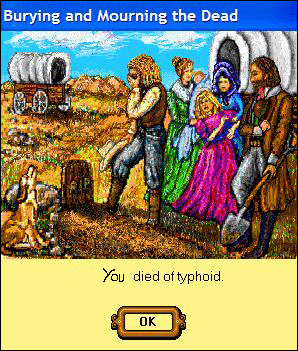
Over the past twenty years, our society, I think I can safely say, has developed a slight obsession with video and computer games. Thanks to seemingly daily advances in technology, the gaming industry seems to have spurred (your welcome Danny) a gaming epidemic that is overtaking our youth. Perhaps a little bit of an exaggeration, but I have yet to find a better example of an industry that has embraced technology and innovation more. Considering I was blown away by the likes of Oregon Trail (Dysentery always got me though),Where in the World is Carmen San Diego, and Street Fighter, I may be out of my league discussing the most recent editions of World of Warcraft, NFL Live, and Call of Duty. Maybe it's because my brothers and most of my guy friends DON'T allow me to play their Xbox Lives and Playstations, I have had the pleasure and ample amount of time to watch, observe, and become fascinated by the intricate details, features, and life-like graphics of the most popular games on the market. While I have grown up in this era of gaming-innovation, I am still amazed at the capability of anyone with the proper subscription and headgear to communicate, converse, and well, most importantly talk smack, with fellow gamers to anyone in the world! This observation also provided the time to make the realization that, most importantly, and perhaps even unintentionally, all you gamers out there serve as connectors for companies like EA sports, Nintendo, SEGA (is that even still around?), and all the others that produce your precious commodities. Because technology allows for gaming enthusiasts to share opinions, recommend, promote, and spread the word about the games they play, know, and love; they inadvertently become salesmen, gatekeepers even, that ultimately affect the success or failure of new games.
In Malcolm's words, the stickiness factor isn't even a question in the gaming industry. In this instance, gaming has spread virally and globally over the past two decades. What stereotypically started out as a product directed towards the youth, has exploded to all ages, races, male and female alike, thanks to Wii, Wii fit, Dance Dance Revolution, and many others. As the gaming industry continues to tweak, modify, improve, and innovate, the question in the back of most people's minds is "what can they possibly think of next"? Are holograms the next big thing( don't act like you haven't thought about it!)? But in all seriousness, the way we play has become part of our daily lives. Social gaming provides us with an opportunity to educate, entertain, to work out, and most importantly, ROCKOUTTT together. Is there a tipping point for this unique product medium that could possibly go too far? When will virtual reality become our "real" reality? How much further will change and innovation take the gaming industry?
Monday, February 15, 2010
Adapt or Fail- the new fight or flight?
The Fight or Flight response is something we have all run into a time or two in this challenging world we live in. When we perceive threats, an attack, or god help us all, CHANGE, to our survival or living environment, the argument states we have one of two options: peace out (yes that is a technical term) and flee the scene, or stay and fight for what we want to protect. However, if we apply the fight or flight context to the Corporate world, results may vary ever so slightly. What happens when mergers occur, new management takes over, and suddenly all the comforts of your working world are being attacked? Will employees adapt to new leaders, new policies, and most importantly, new norms in order to keep the company alive or will the change eventually kill the organization?
This type of change can occur rapidly, seemingly almost overnight to some. Or it occurs gradually over time as management slowly starts to instigate new procedures overseen by new faces, mixing up the status quo little by little. Either way it happens, getting an organization to accept and adapt to the changes becomes the key. Easier said than done my friends. Speaking from personal experience as a collegiate athlete, I went through three coaching changes during my career at Radford University. Talk about survival of the fittest. Not only did we have to change the way we physically played the game, and relearn skills the way they taught it. But we had to adjust to new personalities, new rules, and new leadership. One of the main reasons most of us survived were due in part to captains of the team. The Captains served as connectors between head coaches and the freshies, and everyone else in between. Because we saw our team as our family, our captains were our strong ties. The ones we trust, follow, and expect to tell us it's okay to change. They lead by example. By doing things the way the new coaches said to. They were the liaisons between the old way of performing and the new and unknown.
The same situation can be transposed to any organization undergoing similar restructuring. Organizations with strong internal leaders will be more likely to come out unscathed in the changeover process. If they're smart, new management will use them as connectors to diffuse new ideas into the existing culture. They have the high social capital, the ties, and the ability to relate, understand, and influence the rest of the employees that make up the organization as a whole. In theory, the trickle down effect takes place as change works its way into the pulse, the daily routines, the life of the organization. As a result, a different, perhaps new and improved culture emerges within the organization. The adaptation process allows companies to survive the transformation.
Is failure the only other option for organizations who decide to flee, or at the very least, ignore the new guys up top? What are your opinions? Do you think there is a gray area where companies have other options besides adaptation or demise? Check out Steve Tobak's CNET blog on why mergers ultimately fail. Tobak is the managing partner of Invisor Consulting LLC, and I found his perspective on corporate behavior interesting, perhaps you will too.
Saturday, February 6, 2010
What Strand Of The Change Virus Are You?
What is it about the notion of change that brings about one of two reactions: resist it or embrace it? When it comes down to it, our human nature divides us into two groups: the ones that hate change, the same group that likes the comfort of a routine and knowing what to expect on a daily basis; and those who are seeking a way to bring a fresh, new perspective to their daily lives. As we discuss certain companies, industries, and people who fall into the latter of the two groups, I can't help but wonder what it is that separates the embracers from the resisters.
For those of us in Leadership this semester, is change something that is born in us? Like trait leadership, are there those select people who simply possess the innate characteristic that allows them to instill ideas of change in themselves and others? Or is change something that can be learned and possessed by all people in different levels and abilities? From my perspective, change is something I have always viewed personally. I don't necessarily think of a singular company, (think corporations like Apple or Google) as the reason change occurs. I think of the people who make up that company, who personally think of new ideas, products, or processes that spurs change. Perhaps inventor is a more appropriate word choice. But whatever you call it, I think it takes a certain type of person, including their characteristics, and their own perceptions of the world around them, to spur what Gladwell refers to as the epidemic of change.
In my own family, I immediately think of my grandfather when innovation comes into conversation. Mr. Wallace Almquist III isa civil engineer who was the President of Colombia Oil and Gas for the majority of his professional career. An engineer, is someone I think of who naturally enjoys taking things apart, figuring out new and improved ways of doing things, mixing up and changing the system in order to make a process better or perhaps more productive right? Ironically, this is the same man that refuses, and I mean will argue with anyone, about computers and how much they have improved our lives today. He wants nothing to do with them. In fact, he insists that his 100 year old typewriter can suffice to get anything he needs done and do it just fine. So riddle me this: how is it that change ever occurs when there are millions of people just like my Grandfather who pose such a strong resistance to the epidemic? Who are these leaders, these innovators, the "connectors, mavens, and salesmen" as Gladwell refers to them, that are able to diffuse new ideas that really do change our world. How do they get someone like my stubborn Grandfather to change? Is there a tipping point in all of us that ultimately enables even the strongest strand of resisters to embrace change? When does the "stickiness" factor finally take over and allow the idea or innovation to spread?
For those of us in Leadership this semester, is change something that is born in us? Like trait leadership, are there those select people who simply possess the innate characteristic that allows them to instill ideas of change in themselves and others? Or is change something that can be learned and possessed by all people in different levels and abilities? From my perspective, change is something I have always viewed personally. I don't necessarily think of a singular company, (think corporations like Apple or Google) as the reason change occurs. I think of the people who make up that company, who personally think of new ideas, products, or processes that spurs change. Perhaps inventor is a more appropriate word choice. But whatever you call it, I think it takes a certain type of person, including their characteristics, and their own perceptions of the world around them, to spur what Gladwell refers to as the epidemic of change.
In my own family, I immediately think of my grandfather when innovation comes into conversation. Mr. Wallace Almquist III isa civil engineer who was the President of Colombia Oil and Gas for the majority of his professional career. An engineer, is someone I think of who naturally enjoys taking things apart, figuring out new and improved ways of doing things, mixing up and changing the system in order to make a process better or perhaps more productive right? Ironically, this is the same man that refuses, and I mean will argue with anyone, about computers and how much they have improved our lives today. He wants nothing to do with them. In fact, he insists that his 100 year old typewriter can suffice to get anything he needs done and do it just fine. So riddle me this: how is it that change ever occurs when there are millions of people just like my Grandfather who pose such a strong resistance to the epidemic? Who are these leaders, these innovators, the "connectors, mavens, and salesmen" as Gladwell refers to them, that are able to diffuse new ideas that really do change our world. How do they get someone like my stubborn Grandfather to change? Is there a tipping point in all of us that ultimately enables even the strongest strand of resisters to embrace change? When does the "stickiness" factor finally take over and allow the idea or innovation to spread?
Subscribe to:
Posts (Atom)

